
Important: Membership Needed!
To use the practice exams below you need the AHUF or ATPL All 7 Practice Exams Membership!
Use the button to purchase, or if you already have one of these memberships click here to login.
ATPL Human Factors Practice Exams (AHUF)
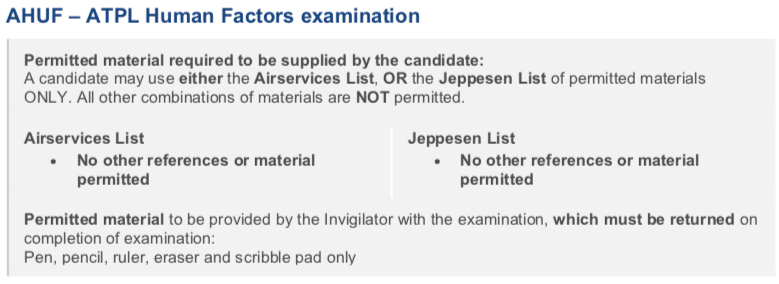
Before completing exams read the Assumptions & Equipment Lists at the bottom of the page, from CASA AHUF page. 1.25 hour exam, 70% pass mark.
Very significant bank of new extra questions added Sept 2025. Contains 500+ unique questions.
ATPL Human Factors AHUF
CASA-style ATPL Human Factors questions
Designed to reflect real exam wording
Focus on commonly tested concepts
Built for repetition and retention
ATPL TEM 1
ATPL Human Factors Practice Exam Questions
Do 20 of 30 questions
ATPL TEM 2
ATPL Human Factors Practice Exam Questions
Do 20 of 30 questions
ATPL TEM 3
ATPL Human Factors Practice Exam Questions
Do 20 of 25+ questions
ATPL TEM 4
ATPL Human Factors Practice Exam Questions
Do 20 of 25+ questions
ATPL TEM 5
ATPL Human Factors Practice Exam Questions
Do 20 of 25+ questions
ATPL Flight Crew Communications
ATPL Human Factors Practice Exam Questions
Do 20 of 30+ questions
ATPL Ergonomics
ATPL Human Factors Practice Exam Questions
Do 16 questions
ATPL Human Factors 1
ATPL Human Factors Practice Exam Questions
Do 20 of 50+ questions
ATPL Human Factors 2
ATPL Human Factors Practice Exam Questions
Do 20 of 50+ questions
ATPL Human Factors 3
ATPL Human Factors Practice Exam Questions
Do 20 of 40+ questions
ATPL Human Factors 4
ATPL Human Factors Practice Exam Questions
Do 20 of 50+ questions
ATPL Human Factors 5
ATPL Human Factors Practice Exam Questions
Do 20 of 45+ questions
ATPL Human Factors 6
ATPL Human Factors Practice Exam Questions
Do 20 of 30+ questions
ATPL Human Factors 7
ATPL Human Factors Practice Exam Questions
Do 20 of 30+ questions
ATPL Human Factors 8
ATPL Human Factors Practice Exam Questions
Do 20 of 25+ questions
The overall result for this subject is excellent, indicating a sound command of the subject. As a general guide to further improvement, the frequently occurring KDR items were:
- Error management
- TEM – definition of terms and types of threats, errors, UAS, etc.
- Management of Undesired Aircraft States
- Types of human errors, its prevention and counter measures
- Communication styles and decision making processes
One candidate said expect around 42 questions made up of something similar to this:
~10 Basic HF
~5 Principles of TEM
~5 T&E identification
~10 Countermeasures
~10 MCC/CRM
This means TEM is a really major component for some candidates. This is a trend we are hearing, however this can change without notice and some candidates across all exams get some exams that do not reflect what others say. So you must prepare across the entire syllabus with an emphasis on TEM.
This is generic feedback to help candidates prepare. Everyone wonders will CHUF be the same as AHUF. There is a lot of the same topics, but the questions expect a deeper understanding.
CHUF may ask questions like “How long should you wait after giving blood” whereas AHUF might ask say “Pilots should wait 24 hours after giving blood because:” AHUF definitely assumes you had the basic level of knowledge and wants you to explain the reasoning behind it.
Another example is in CHUF, the TEM questions might give you an error that was committed, then
asks you to state what type of error it was. In AHUF, the questions are more likely to give you a scenario with
multiple threats, and asked you to identify where the latent threat originated or they may tell you
that an aircraft handling error happened, in a scenario with about 5 errors, and ask you to identify a
countermeasure that would have mitigated the handling error, meaning you first have to identify and
isolate that specific error, then decide when and which countermeasure needed to be implemented.
AHUF has very ambiguous questions on TEM, CRM, MCC and countermeasures. Multiple ‘correct’ answers seem
common. Also be careful with ‘buzz words’ and sentences you recognise that have been put in
specifically to bait you into clicking a familiar answer. Very wordy questions that may have 40-50 word scenarios
followed by a “What should the pilot have done” or “Where in this scenario was the error made”.
Most TEM is scenario based
3 questions on UAS
Eye movements and visual scanning, with or without the saccade rest cycle
Pills causing drowsiness
Hypoxia and hyperventilation 3-4 questions
3-4 questions on eyes, ears, postural ques and dark adaptations
Tem models – know TEM at least 15 questions from TEM
Sops, countermeasures, errors
Know types of countermeasures and sub types of counter measures
What mode of communication to use in situations
Personality types
Distractions causing UAS and how to initially react
Aspirin long term effects
Stress management and also effects of stress on performance
Flying long haul in summer – health management in the cockpit
Compression or extension
RTQ carefully, it’s all basic stuff you will study, just warped and twisted by CASA
CASA Nominated Reference Material:
a. Air Craft – Human Factors & Limitations by TonyWilson b. Human Factors for Pilots by Roger G Green et al
c. Human Factors in Flight by Frank H Hawkins
d. CAAP 5.59-1(0), Teaching and Assessing Single Pilot Human Factors and Threat and Error Management
e. Human Being Pilot by Aviation Theory Centre
What Is Examined?
Examination tests Unit 1.6.3 but may include items from earlier Units, common to Helicopter and Aeroplane. In particular the following items:
• Item 2 Aviation Medicine.
• Item 3 Human Information Processing.
• Item 4 Human Behaviour.
• Item 5 Flying and Health.
• Item 6 Threat & Error Management.
Questions are typical of those involving multi-crew, turbine powered, high altitude, high speed aircraft on domestic and international flights.

